iBook Battery Problem

(Update, Aug 2006: Info on the Apple notebook battery recall here. This entry is about an older issue.)

iBook batteries are being killed, and the culprit for many (1, 2, 3) seems to be the OS X 10.2.4 upgrade. My own iBook (8 months old this 30th) is a recent victim as well, and its unplugged lifespan has, in a matter of weeks, deteriorated: from three hours, to one hour, to thirty minutes, to five. Since my refurbished unit is not covered by the standard Apple warranty (Silly me, I still have three months left on my refurb warranty after all) I’ve had to try every trick in the book, but to no avail.

As far as I can tell from previous discussions, (my own technical knowledge is limited, but I know a few practical things about Li-Ion and NiMH batteries from my Globe days) the OS X 10.2.4 upgrade seems to have irretrievably affected something in the battery’s own power management unit, so that it reports a full charge when in truth it is still at dangerously low levels. The undetected deficiency catches up with the portable user with a sudden sleep/shutdown at what still seems like near-full battery capacity.
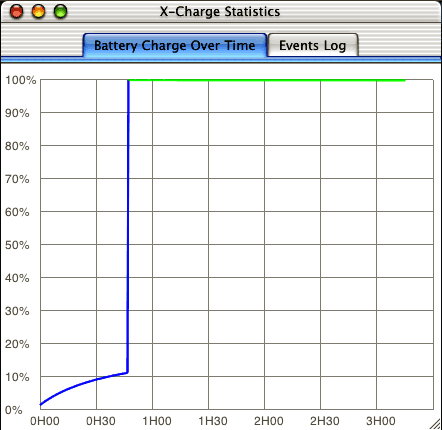
X-Charge screenshot, showing sudden jump in battery's reported charge.

This X-Charge screenshot shows the sudden jump in the battery’s apparent capacity from just above 10%. I think it’s safe to assume that its true capacity is still stuck at around 10%, and it is just not increasing because the battery’s own firmware (?) now reports that it is fully charged.

From here, I’m unsure as to whether I should address the issue by purchasing a new battery. Perhaps it would be wiser to just wait till I can buy a mid-range Powerbook with Panther (hopefully with less buggy power management) later this year. For now, I’m stuck with a small, white, portable desktop machine — which, in truth, is still more than I could ask for.

Ionospheric Luminescence

East-coasters, watch the skies tonight for high, glowing clouds, as NASA fires rockets carrying combustible chemicals into the sky to study our planet’s ionosphere. (Via Spaceweather.)

Update: Webcast page.

Update 2: Oh, bah. Launch scrubbed till tomorrow night.

I’m reminded, just a bit, of Projects Argus and Starfish, a series of tests in the 1960’s, in which nuclear devices were set off at various levels in the upper atmosphere (including a megaton-yield suborbital device detonated at 400km) to test the possible effects of nuclear detonations at high-altitude and in outer space. These ionospheric chemical-burning tests are far less explosive, of course.

Vitaminaffeine Water

Glaceau has a good branding strategy going with their packaging: each variety of “vitamin water” has a witty description under its single-word name. Right now I’m drinking “Revive,” which tells me, among other things:

active ingredients – see contents on label.

inactive ingredients – see contents on your couch.

Unlike Gatorade or V8, Vitamin Water has 0mg sodium. The catch is, the bottle doesn’t tell you how much caffeine is in there. Apparently, there’s a lot. No wonder it’s so good.

Misererail redux

I’ve updated Miserere and Rail a bit. Miserere’s sped-up sound should now sync with the Latin text, and both pieces now have preload counters: a simple implementation of FlashMX’s getBytesLoaded() and getBytesTotal() functions.

Mobrownpau

I’ve been watching Moblogging.org for possible mobile solutions for my blog, since the Bloggerbot has been down for months now. My prepaid service with T-Mobile doesn’t seem to be able to handle SMS-to-email, so my only available data options are straight SMS, or AIM, neither of which present any immediately apparent solutions. Until such time that I can get a better cellphone subscription which gives me a wider selection of data services, the “Mobrownpau” will remain an elusive dream.

Old-school blogging in miniature

Various webloggers have lately been making use of sidebar blogs as an alternative venue to peripherally collect links without interrupting the thematic flow of the main weblog. The links-only format harkens back to the original structure of the blog as web content filter, only in miniature format. Along those lines, I accepted an invitation from Jesper to co-author “Mini,” a remote collaborative sidebar blog, included via PHP and formatted via CSS near the bottom of my sidebar.

Seeing as I have only partial control over Mini, there’s a chance that questionable or inappropriate links might appear. Should you see any content ill-behooved to a Christian blogger’s sidebar, kindly contact me, and I’ll see about applying some preg_replace() filters. Or big black boxes.