JFK-LAX-HKG-MNL

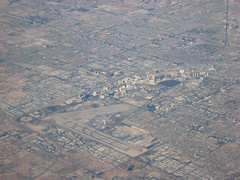
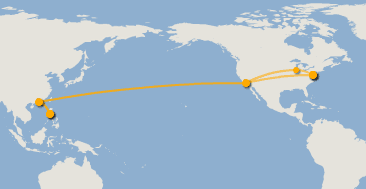
From JFK Airport, the trip had three legs: 6 hours on United to Los Angeles, 16 hours on United to Hong Kong (where we would spend an overnight layover), and 2 hours on Philippine Airlines to Manila. Highlights of the flight included flyovers of the Grand Canyon, Las Vegas, and Siberia; an overnight layover in a hotel in Tung Chung, and a bump up to upper-deck business class on the PAL 747 between Hong Kong and Manila. A selection of photos follows.

IMG_0961.JPG

IMG_0971.JPG IMG_0995.JPG

IMG_0998.JPG IMG_1035.JPG IMG_1040.JPG IMG_1050.JPG IMG_1104.JPG

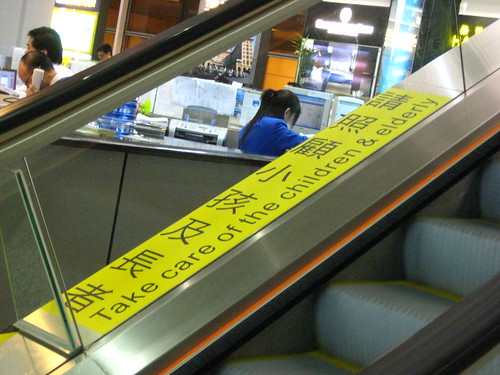
In HKG, words of loving wisdom on the escalators:

IMG_1054.JPG

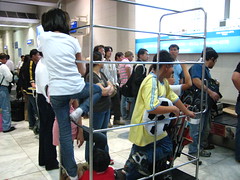
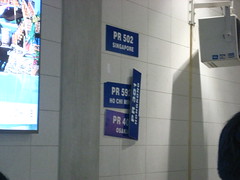
In MNL (PAL Terminal 2), scenes of chaos and slapped-together airport management:

IMG_1118.JPG IMG_1117.JPG

Full photoset from just the plane rides here. Enjoy.

The Trip to JFK Airport

To make it to a 6AM flight out of JFK from the NJ suburbs while spending as little as possible on transportation, we decided to go the ultra-hard but super-cheap way: NJ Transit to Penn Station, LIRR to Jamaica, and AirTrain to the airport — leaving at midnight to catch the last of the NJT trains. (LIRR trains to Jamaica run all day and night so late night rides are not a problem.)

It is not a trip we will ever be repeating.

Things began to go wrong right before the first leg of our trip, waiting at the NJT station: a screw fell out of the handle of my heaviest rolling suitcase, so that I had to lug it from its lower leather handle, while holding a heavy duffel bag with a previously broken shoulder strap in another hand. Our bags, four pieces in all and ranging from 30 to 50 pounds each, took up a whole pair of facing seats all by themselves. (Fortunately, it was a mostly empty train.)

It was a grueling bag-lug through Penn Station (punctuated by the usual over-loud baroque guitar music) to the LIRR concourse, where we had to figure out that Jamaica-bound trains don’t say “Jamaica” on the sign, but the last stop on the line, necessitating a look at the large system map. When the train arrives at its designated track, you are not told that the elevators are way off in another concourse that descends to the same platform. Unlike the NJT, the LIRR train was quite crowded, without room for our massive and numerous suitcases.

At Jamaica Station, Metro farecards are needed to transfer to the JFK AirTrain, $5 to enter through the turnstiles. My card had only $4 on it, but gladly I had a dollar bill and the patience to navigate MTA’s annoying “PRESS START” farecard interface. Once through the turnstiles, a row of baggage carts brought sighs of relief, and we gratefully loaded our bags onto one, little knowing that the cart would soon be our undoing.

There’s something you need to know about the JFK Airtrain: it lists. Train cars lean in to each stop, forming a tiny step-up — not enough to trip up a person, but enough to catch the front wheel of a loaded baggage cart. The cart stops, bags piled atop it fly off, and suddenly one is trapped between train car and airport terminal, cart stuck in the gap, two errant bags strewn out on the station floor, train doors ready to close at anytime, passing security guard muttering oh-so-helpfully that “you should’ve pulled the cart.”

Somehow I managed to grab the bags that had flown off and pull the cart back into the train as the doors insistently attempted to crush all between them. While making sure the contents of a duffel bag had not been damaged, I closed its zipper with rather more wrath than was warranted in my anger at the cart-gap incident, and tore it clean off its teeth, leaving the bag gaping — for check-in. That was two bags broken.

We settled back to re-traverse the circuit of the airport to get to our target Terminal 7 — which it turned out was closed. Apparently certain JFK airport terminals have closing times — not just for shops and check-in counters, mind you, but the whole terminal is locked up, and people asked to leave. And that’s an international terminal. Fortunately Terminal 4 was still mostly open, with a 24-hour Sbarro which served crisply burnt day-old veggie pizza to tide us over at 3AM, and a SecureWrap outpost to mummify my zip-torn duffel bag in multiple layers of clear plastic.

At 5:15 AM Terminal 7 opened. We had circumvented United’s notoriously rude check-in service with online check-in, and needed only pause to drop off our battle-scarred bags at the check-in counter before going through the requisite laptop-shoes-belt-311-ziploc-bag dance of TSA Security Theater. We boarded, sat, sighed, and agreed to never go through JFK Airport ever, ever again, especially not coming from New Jersey.

Away Message

Happy 2008! Amy and I were in the Philippines for two weeks and now we are in Hong Kong for a couple of days to sightsee. (Trip map above.) Internet access in both locations has been neither frequent nor speedy for us, so I have not been able to update much, and will probably not be able to post any new stuff till we’re back in DC later this week.

For now, please enjoy these retro-dated holiday posts: Fifty Ways, Drive-Thru Nativity, and NJ Christmas 2007.

Tali.jpg

Tali.jpg I’m at the beach right now. Back in 2008 with more. All comments will be queued for moderation till then.

(Tali.jpg uploaded by brownpau.)

NJ Christmas 2007

IMG_0839.JPG IMG_0850.JPG IMG_0898.JPG IMG_0883.JPG IMG_0929.JPG

IMG_0938.JPG IMG_0874.JPG

IMG_0892.JPG

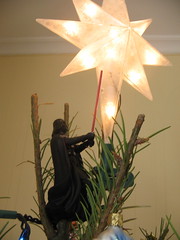
We were in New Jersey this Christmas with Amy’s family. There was Italian food and prime rib, and we got a Metropolitan Museum cat block and sweaters and a couple of Star Trek DVDs and some cash, and I got to watch A Christmas Story for the first time ever, along with The Simpsons Movie. We also saw a car with reindeer antlers, and hung a Moravian star on the tree. It was a nice, quiet, peaceful few days with the in-laws to celebrate Christ’s birth.

Then we flew to the Philippines.

Fifty Ways

Part of US News’ Fifty Ways to Improve your Life in 2008 year-ender feature was an informal video of assorted US News staff giving the fifty tips (video viewable at the upper right of the “50 Ways” page). I make an appearance at around 3m 20s, telling you to smell the roses, because smelling roses is ostensibly good for the brain. (Unfortunately the location I was shooting in lacked flowers of any kind, so I was unable to introduce any expository props into my brief soliloquy.) I had not realized I appear so stiff and expressionless on camera. Next time I am invited to appear in a video I will have to try and channel The Shat.

Russell makes an appearance directly after as well, saying something about corn.

Eduardo San Juan and the Lunar Rover: Message from “Skeet”

Got an email from Otha “Skeet” Vaughan Jr., who worked with Wernher von Braun at ABMA, and on the Apollo program and the lunar rovers:

Reference the “The Lunar Rover and Ed San Juan,” you are correct; he did some early work on developing a mobility program for Hayes International in Birmingham and later at Brown Engineering, but as you say he was not the inventor of the Lunar Rover.

We started working on the MOLAB designs in the late 50s. Later we progressed to the Mobility Test Articles which replicated the mobility performance of the MOLAB concept. Later I was responsible for developing the Lunar Environment Design Criteria for the Lunar Rover.

Best source on Rover information at present is developed in the book “Lunar and Planetary Rovers” by Anthony Young. I also worked in the design of the Lunar Driving Simulator that was developed at MSFC.

The rover was not designed by one person but many people had input to the design as it progressed.

Otha H. “Skeet” Vaughan Jr.

ABMA NASA MSFC Retired

Mr. Vaughan is more recently famous for his work in the observation of meteorological phenomena from orbit, including the discovery of sprites and jets.

Early Lunar Rover Wheel Design

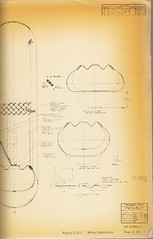
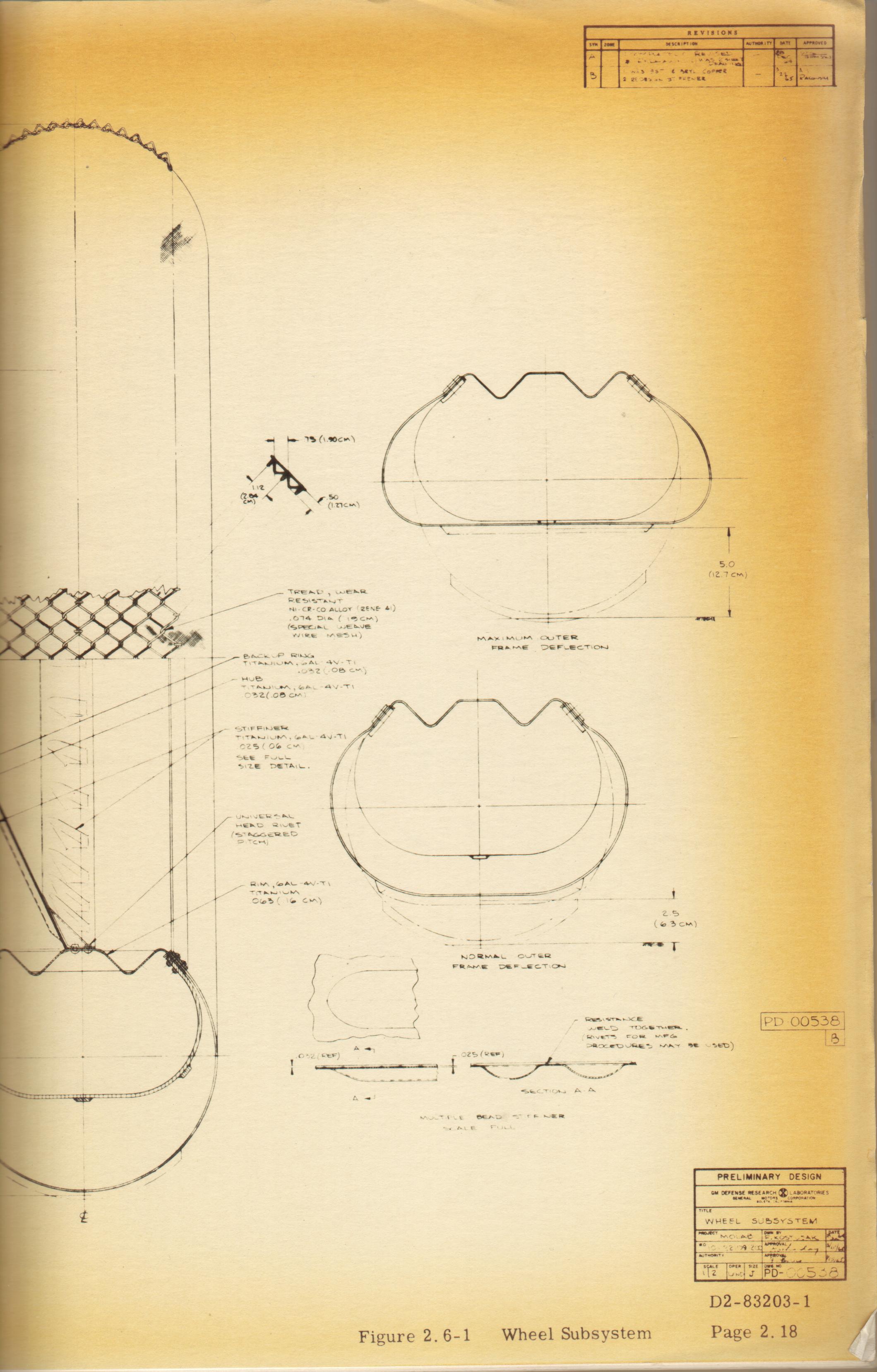
LRV Wheel Another note from Nikodemski on the lunar rover, this having less to do with San Juan and more on developments in lunar vehicle design among his Space Age contemporaries. His letter is stuffed with fascinating historical and technical detail, and includes a scan of an early lunar rover wheel design for the MOLAB project, which I am sharing here (view in full size on Flickr) with his assurance that it is public-domain material. You can compare this wheel design with San Juan’s “tri-flexo wheel” in his Hayes MOLAB proposal linked from here. Text from Nikodemski follows:

A note from Nikodemski to me:

This is all public-domain stuff, and is not proprietary to any companies. Attached below is a portion of a letter which I wrote to some of the Lunar Rover and Apollo designers, and am awaiting feedback and forward planning for the next reunion. Attached also is an partial design drawing of a lunar wire-frame wheel (approx 600Kjpg). You are free to publish this drawing, for comparison purposes. This was recorded as a 300dpi BMP, but cut to 100% JPG format, to reduce size. As we speak, Sam Romano and Ferenc Pavlics are being filmed for a TV series presentation of the Space Program. I was able to verify from my own material, that there was indeed a Hayes International Corporation, which presented to NASA at November 1964. Eduardo San Juan was undoubtedly the same person mentioned in your recent posting, of a proposed Lunar Rover. Unfortunately, as per the text below, many other companies had already offered similar competitive concepts, as we GM-DRL also did.

Competition was exceedingly tight in that era, and we won the competition mostly because we were able to deliver the vehicle in such a short time-frame. The LSSM final report, published in July-1966, lists forty-seven (47) different configurations which were proposed and analyzed, before a final decision was made by NASA, as to which one would be built for the actual ascent. We had been doing extraterrestrial vehicular prototyping all the way back to the mid-50’s, via M. G. Bekker’s work, and had a significant knowledge advantage over the competition. The Army Ballistic Missile Agency (ABMA) 1959 proposal was actually based off some of Bekker’s “floater” work, with the Balute wheels.

At that time, the composition of the moon was not actually known, and various researchers were proposing that it consisted of anything from hard-solid rock, to styrofoam-like surfaces of vast porosity, including the fear that an Astronaut would literally sink-in over his head, and going all the way out to “frozen-free-radical” chemical surfaces, where the Astronauts shoes would either dissolve or explode, as soon as he stepped down.

It was not until the Soviet LUNA probes (proposed circa 1955, development started circa 1958, attempted failed launches 1963-65, hard-smashed into the moon in 1965, and finally soft-landed Luna-9 in Jan-Feb-1966), that the actual lunar composition became known. The Soviet television and radio-data material was ridiculed over here, as being partially faked, because many Americans did not want to believe they had been beaten to the moon. This material, however, clearly showed the actual compositional density and strength of the lunar soils, which demonstrated that a tractive vehicle could easily pass over the moon’s surface.

After American probes dug-up some local moon surfaces, and measured the resistance forces, fracturing characteristics, size of grains, etc, did an actual dirt-like-mix composition start to evolve. By the time the actual LRV was designed, we had replicas of the moon-dirt delivered to us, as generated from NASA data material, and ground up by contracted dirt-works and quarry companies. NASA delivered this real-fake-simulated dirt, to any participants in the LRV competition, and we used it in vast quantities in the M-over-4 (M/4) testbeds. I remember spending many hours running the breadboard motor-controllers, running over simulated moon-rocks, and watching the wheels get banged up. There was dirt and and general moon-crap all over the various labs. Outside, in the back of the front building of our plant, we had an actual moonscape, which was used for whole-vehicle testing, using a 1G-sized trainer.

We also had a very large vehicle test-track in the way-back portion or our site, which was an Army Tank and Truck track. This had multiple hills, water and mud pits, and sloped surfaces for huge-vehicle testing. At first, the 1-G Trainer wheels were actual rubber tires, which we bought down the street at a local car-parts dealer (may have been the start of DalPozzo), and had the tread ground-off at a local grinding shop. This was to simulate the expected traction, that the true wheel was going to have on the moon. Since the moon is at only one-sixth of earth-gravity, the traction values were expected to be much lower. The rubber wheel essentially ended up being a “baldy”, and had really bad traction on any kind of earth dirt.

As a result of this kind of extensive testing, the actual Lunar Wheels worked very well, and actually had pretty good traction. There are two NASA videos which show the performance under both low-speed and high-speed driving. If you look closely at these, you will see at least one scene, where the LRV actually lifts off the lunar surface. In other scenes you can see the skidding parameters, and the dirt-pumping of the wire-wheels. The wheels actually imbed partially into the soil, and would sink quite low, if not for the floatation offered by the highly evolved chevron and bumper design. Get hold of these videos, and post them for others to see. There is a yearly NASA moon-buggy competition (in Huntsville), which attempts to get modern kids up to our speed, but as you will see, we were way-ahead of them, and way-way-way-above them.

Text of Nikodemski’s letter to LRV/Apollo engineers:

Attached below (approx 600Kjpg) is one of my earliest verifiable records which shows a partial view of an actual Lunar Rover airless wheel design. This scan is from a PDS study titled “Apollo Logististics Support System (ALSS) Payloads”, prepared by GM Defense Research Labs, for the Boeing Company, under NASA prime contract NAS8-11411. For this study, eight different wheel designs were evaluated, one pneumatic, and the other seven airless, during a program which ran from about 1962 thru 1964. If anyone has any other earlier material, please let me know, or Sam Romano and Ferenc Pavlics. I have other reference LSSM report material which indicates that the earliest actual “proposed” LRV was a 4×4 configuration made by the Army Ballistics Missiles Agency, circa 1959. Aerojet presented a Spacesuit-imbedded-in-Vehicle in 1961. Grumman published a report at about same time, which showed stowage and space-availability concepts, in which a vehicle was also shown. GM-DRL made a presentations to NASA headquarters in 1962 and 1963. Much other subsequent study and proposal material followed in the 1963 and 1964 and 1965 timeframes, from the Aerospace, Bendix, Boeing, Grumman, and Northrop, companies. Later studies were added by the AMF, Chrysler, Hayes, Hughes, Lockheed, and Tinsley companies. Several other commercial organizations, such as magazines and newspapers were also writing-up various speculative articles, all during this era.

In this particular Molab/LSSM study, there is also a mention of the Flying Lunar Rover (FLV) concept, to which I have no other references, except some magazine material which von Braun apparently published circa 1953-54. I have never seen any conceptual drawings of the Flying Rover, and would like to obtain any such material. Additionally I am aware of Army mobility studies (from some of Dr M. G. Bekker’s work), where “balute or balloon” wheels were employed, circa mid-1950s, which were to be used in crossing water, swamps, or extremely volatile or friable soils. Pictures of these vehicles show wire-frame wheels, both with and without grousers. Although air-filled, these were not actually pressurized to any significant extent (some had open axle-holes to allow for exterior attachment to existing axles), and could have been air-vented for use on the moon. Simpler airless wheel designs go back to circa 1920-30s, where steel banded flex wheels were initiated for farm machinery and to improve buggy-ride.

In the attached drawing, the earliest revisions were made Dec-1964, thus the wheel design was obviously being made in 1963 or before. This drawing was signed by these individuals, all but one of whom I know personally: Bev Hockaday, Arnold Rakowski, William Thomson, [unk?] Steffener, Frank Kostusak, Ferenc Pavlics, with one illegible signature. In this 120+page report, other drawings are additionally signed by L. Wilson. If anyone has contact with these individuals (if they are still alive) would you contact them and see if we can find some other similar materials, for a historical record. The earlier the material, the better. I have been made aware that there is group putting together a history of our company and its projects, dating back to 1948 and onward. I will help them with copies of any of my material, as something forms up.
(View full-size scan on Flickr)

Christmas 2007

I Find Your Lack of Faith Disturbing

This has been a very momentous year for me — getting hired, getting married, getting a new place — and I am grateful and humbled by how far God has brought me. But I count it all as unto nothing beside the free gift of redemption I have received from the Savior whose birth we celebrate today.

I know Yeshua “Jesus” Meshiach was not born on Dec. 25th, 0000, and I know the holiday was only later established to supplant older pagan festivals; and yet it is fitting enough that, at the coldest and darkest time of year, we are warmed by the light of love, giving, and togetherness, as Christ came for our salvation when we were most helpless to save ourselves, to bring us into his unity with the Father. So, a happy Christmas to all of you, far and near, and may the Lord give you peace and joy.

“The light shines in the darkness, and the darkness has not overcome it.”